
01
Glass needs a cradle, not a hole
A loose die-cut hole lets the ampoule rock and take the impact at the neck. The cradle is cut to the body diameter and depth, so the vial is held below the score line.
Industry
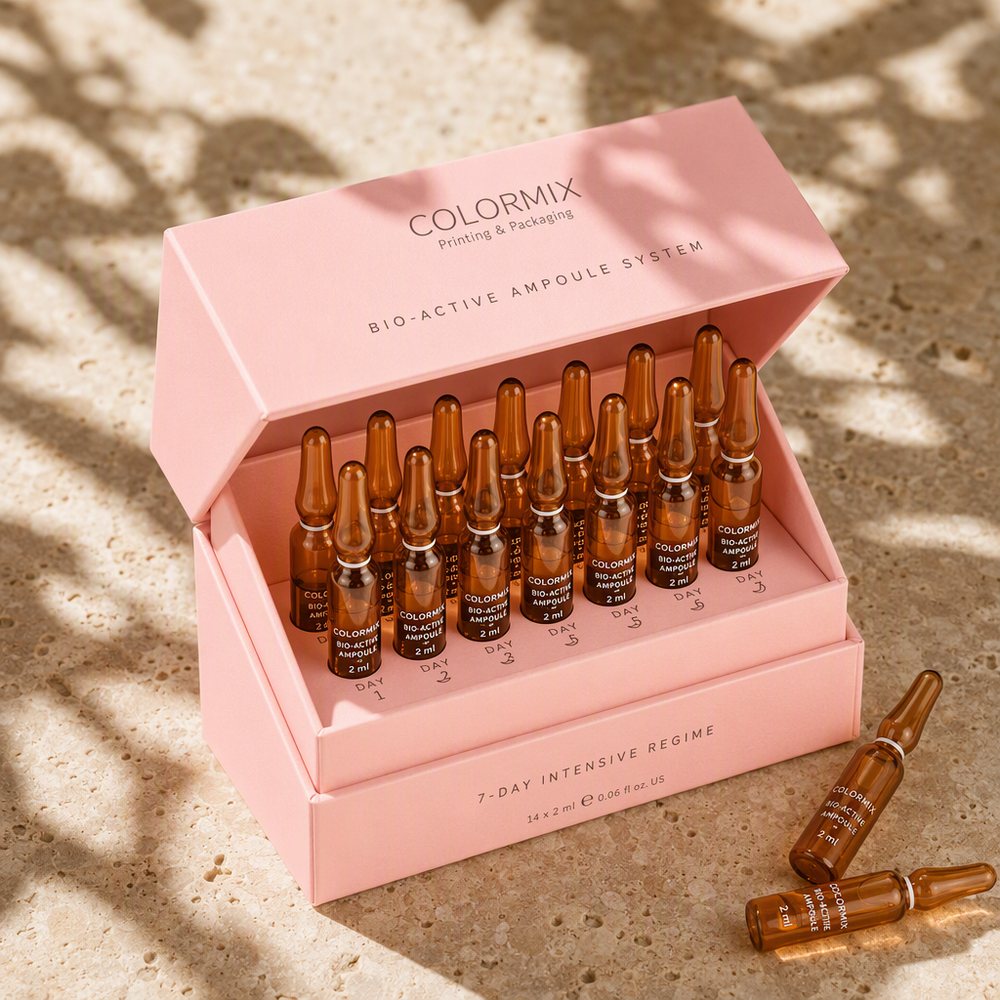
Colormix makes ampoule packaging boxes in Guangzhou, China, from 500 pcs per size, with samples in 3–7 days and bulk in 15–22 working days after approval. The box is a rigid lid and base or flip-lid with a die-cut cradle that holds each glass ampoule upright at a fixed spacing, so a fourteen-ampoule regimen arrives with every vial in its printed position.
An ampoule is glass, narrow at the neck and heavier at the base, and it breaks where it is scored. The packaging decision is therefore a cradle decision: how the vial is held, how far it can move, and whether the box can be opened and closed through a twenty-eight-day regimen without the cradle losing its shape.
The same structure behaves differently across these three situations. They are the first we ask about.
Day-numbered cradle for a course of treatment.
Twenty-eight ampoules in two layers with a protocol card.
Three to five vials in a slim carton.
Three structures cover most briefs in this category. Each is quoted per size, from 500 pcs.
Box with a die-cut cradle holding each vial below the score line.
Two-row presentation with a printed day card.
E-flute outer sized to the box, not to the product.
Four constraints drive most of the decisions here. They are the first things we ask about.
01
A loose die-cut hole lets the ampoule rock and take the impact at the neck. The cradle is cut to the body diameter and depth, so the vial is held below the score line.
02
Seven, fourteen or twenty-eight ampoules turn the tray from one row into two. Day numbering is printed into the cradle or onto a card under the lid.
03
A finger notch under each vial lets the user lift it without pulling on the neck. It is a dieline detail, and it is the difference between a usable set and a broken one.
04
A rigid cradle does not survive courier handling on its own. The set ships inside a corrugated mailer sized to the box, not to the product.
Most brands in this category need three or four of these, not one. Each is quoted separately.
| Component | How it is built |
|---|---|
| Rigid lid and base box | 1.5–2.5 mm greyboard, wrapped and foiled; the base carries the cradle. |
| Die-cut cradle | Paperboard, EVA or moulded pulp, cut to the ampoule body with a finger notch at every vial. |
| Day card | Printed card under the lid numbering day 1 to 28 when the set is sold as a regimen. |
| Corrugated mailer | E-flute mailer sized to the box, with a paper insert for sets that ship on their own. |
| Tissue and care card | Printed tissue and a care card, cut to the box interior. |
Three finishes do most of the work here. The full library, photographed as macros, sits on its own page.
Keeps a clinical surface clean and scuff-free.
Or printed numbers with a foiled border at small sizes.
The insert printed to the same artwork as the box.
Yes. Moulded pulp or a folded paperboard cradle replaces EVA. Pulp needs a thicker wall, which changes the depth of the box.
Yes. Two or three filled vials are enough. A drawing gets close, but the score line and the neck radius decide whether the vial lifts out cleanly.
Fourteen, in two rows of seven, is the most common regimen set. Twenty-eight goes to two layers or a wider box, and both are quoted as separate tooling.
The rigid box is not the shipping unit. We quote an E-flute mailer around it, sized so the set cannot move inside the shipper.
They can, but foil fills in at small type sizes. Printed numbers with a foiled border is the usual compromise.
Get a packaging quote
Product, channel, quantity and target date is enough to start. You get two or three options with the trade-offs, and an itemised quote.
Last reviewed: 2026-10-27