
01
Vial diameter sets the cavity
A 2 ml ampoule and a 10 ml serum vial need different cavity walls. Peptide packaging inserts are cut from the actual glass dimensions, with the vial supported at the shoulder rather than standing loose on its base.
Industry
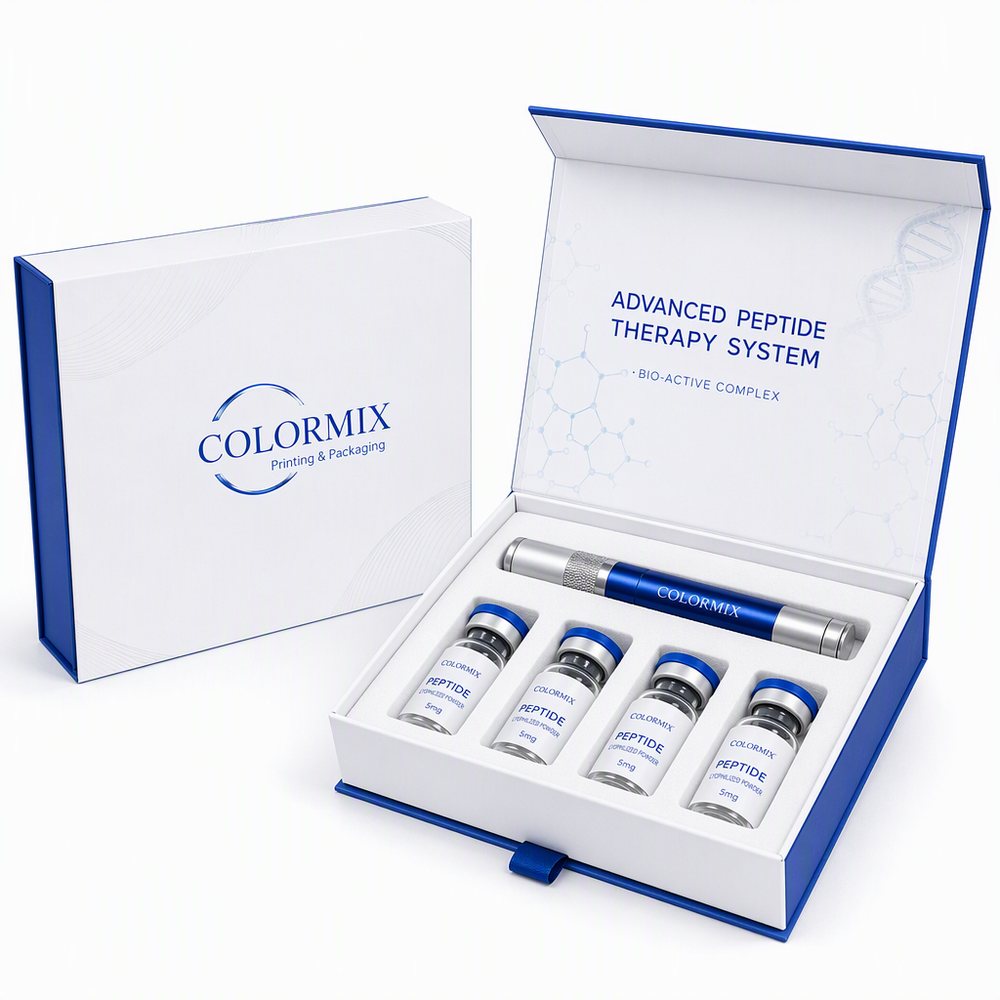
Colormix produces peptide packaging in Guangzhou, China for serum vials, ampoules and application pens, from 500 pcs per size. Digital samples take 3–7 days; production-line samples take 7–10 days, and bulk runs 15–22 working days after approval. Each cavity is cut to the vial diameter and height so the glass is supported at the shoulder, and the box carries the set as one unit rather than as loose parts.
Peptide and serum ranges are sold as clinical sets: several small glass vials, an applicator or pen, sometimes a diluent. The packaging has to hold that set still, present it as a single product, and survive being posted, which usually means a rigid box with a cut insert rather than a folding carton.
The same structure behaves differently across these three situations. They are the first we ask about.
Box holding four to ten vials plus an application pen.
Higher counts with a printed protocol card.
Carton sized to an insulated shipper without movement inside.
Three structures cover most briefs in this category. Each is quoted per size, from 500 pcs.
Greyboard box with a die-cut EVA or paper cradle per vial.
Two-row presentation with a printed inner lid.
E-flute outer sized to the box, not to the product.
Four constraints drive most of the decisions here. They are the first things we ask about.
01
A 2 ml ampoule and a 10 ml serum vial need different cavity walls. Peptide packaging inserts are cut from the actual glass dimensions, with the vial supported at the shoulder rather than standing loose on its base.
02
Small vials in a large box travel. The insert fills the box so nothing can shift, and the lid closes down onto the insert instead of onto air.
03
Vials, pen and instructions sit in one tray with a printed interior, so the box opens as a kit rather than as a collection of parts.
04
Some peptide products need protection from light or from a short temperature swing. Board grade, interior colour and the option of a foil or opaque liner are specified with that in mind.
Most brands in this category need three or four of these, not one. Each is quoted separately.
| Component | How it is built |
|---|---|
| Rigid set box with vial insert | Lift-off lid on a wrapped greyboard box, with an EVA or pulp insert cut for four to ten vials and one pen. |
| Magnetic presentation box | Hinged lid with concealed magnets for clinical skincare sets, printed inside the lid with the protocol card. |
| Single vial carton | Folding carton with a folded fitment for one ampoule or vial, used for samples and travel sizes. |
| E-commerce mailer | Corrugated mailer sized around the set box, with corner clearance for glass travelling by post. |
Three finishes do most of the work here. The full library, photographed as macros, sits on its own page.
Clean clinical surface that resists scuffing in a bag.
Mark and dosage line, legible without looking cosmetic.
Protocol or batch card sitting under the lid.
EVA foam gives the most control because the cavity is cut to the exact vial profile. Molded pulp suits heavier runs and paper-based requirements, and thermoformed PET gives a clean, rigid cavity for premium sets.
Yes. The insert is cut from one block with a vial row and a longer channel for the pen, so the components cannot touch each other.
Yes. Clinical sets usually carry the protocol or brand story inside the lid, printed on the wrap before assembly.
500 pcs per size, for every structure.
Get a packaging quote
Product, channel, quantity and target date is enough to start. You get two or three options with the trade-offs, and an itemised quote.
Last reviewed: 2026-10-27