
01
Aroma and moisture decide the barrier
Tea takes up odour from board and adhesive. Where the leaf is exposed, we specify a food-grade liner or an inner bag rather than rely on the outer print to do the work.
Industry
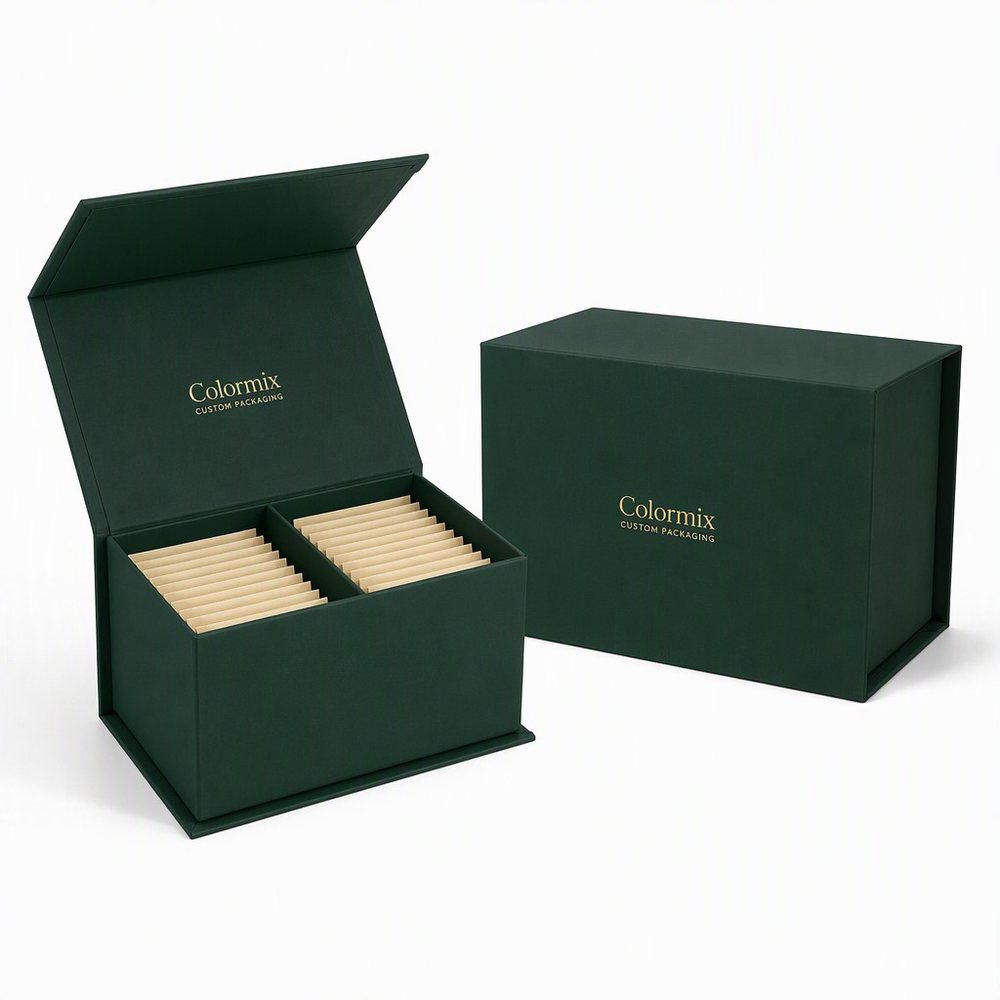
Colormix makes custom tea packaging boxes in Guangzhou, China, from 500 pcs per size: samples in 3–7 days and bulk in 15–22 working days after approval. A tea range usually needs two structures — a compartmented rigid box for wrapped sachets and a folding carton for the single-SKU retail line — printed from the same artwork so the gift set and the shelf carton match.
Tea is sold by weight, by ritual and by story, and the box has to carry all three. The practical constraints are moisture, aroma and the fact that a stack of sachets has to stay square in the hand. That is why tea packaging is usually a cut tray inside a rigid lid and base or flip-lid box, with a printed carton for the everyday line.
The same structure behaves differently across these three situations. They are the first we ask about.
Twelve, twenty-four or thirty-six wrapped sachets in a compartmented tray.
Lined carton with an inner food-grade bag.
Small cartons with single-serve envelopes.
Three structures cover most briefs in this category. Each is quoted per size, from 500 pcs.
Wrapped greyboard with a two-compartment tray.
350 gsm carton for a single SKU on shelf.
Die-cut aperture where the leaf itself has to be seen.
Four constraints drive most of the decisions here. They are the first things we ask about.
01
Tea takes up odour from board and adhesive. Where the leaf is exposed, we specify a food-grade liner or an inner bag rather than rely on the outer print to do the work.
02
Twelve, twenty-four or thirty-six sachets change the tray depth and the number of compartments. The tray is cut to the count, so the stack does not slide when the box is tilted or posted.
03
A rigid box earns its cost in a gift set. A folding carton does the work on a shelf. Printing both from one artwork keeps the range recognisable without paying rigid prices on every SKU.
04
Deep green and black are the default tea colours, and both swallow four-colour print. Gold or copper foil on the dark wrap is usually what makes the mark legible at arm’s length.
Most brands in this category need three or four of these, not one. Each is quoted separately.
| Component | How it is built |
|---|---|
| Rigid flip-lid or lid and base box | 1.5–2.5 mm greyboard wrapped in printed paper, with a gold border line if the artwork calls for one. |
| Compartment tray | Die-cut paperboard or EVA, cut to 12, 24 or 36 sachets, with a finger notch for lifting the stack. |
| Retail carton | 300–350 gsm folding carton for single SKUs, printed from the same artwork as the rigid box. |
| Window carton | A die-cut window with PET or PLA film where the leaf or the sachet itself has to be visible. |
| Sleeve and carrier bag | Printed sleeve around the rigid box, and a matching paper bag for the retail counter. |
Three finishes do most of the work here. The full library, photographed as macros, sits on its own page.
The traditional cue on a dark green or black wrap.
Protects the print from damp hands in a kitchen.
Reads at shelf distance where four-colour print on dark stock does not.
Yes. Loose leaf usually goes in a lined rigid box or a carton with an inner food-grade bag, because the leaf needs a barrier that printed board does not provide.
Twelve, twenty-four and thirty-six are the common layouts. Above that the tray splits into two layers, which changes the depth of the box.
We print the box, the tray, the sleeve and the bag. Sachet film is made by a separate converter; we quote the box to the filled sachet size so the two fit.
No. 500 pcs applies per size and per structure, so a gift box and a retail carton in the same range are two minimums.
It can be printed in a metallic ink, but on dark stock the foil reads sharper. Both are quoted, and the difference is shown on the sample.
Get a packaging quote
Product, channel, quantity and target date is enough to start. You get two or three options with the trade-offs, and an itemised quote.
Last reviewed: 2026-10-27