
01
The flacon sets the cavity
Bottle height, shoulder width and cap diameter decide the insert depth and the clearance at the neck. A 50 ml and a 100 ml of the same silhouette usually need two different inserts rather than one scaled up.
Industry
Colormix makes perfume packaging boxes in Guangzhou, China, from 500 pcs per size. Digital samples take 3–7 days; production-line samples take 7–10 days, and bulk runs 15–22 working days after approval. The bottle governs the structure: cavity depth, neck clearance and the closing method are all set from the filled weight and from the way the flacon is presented when the box opens.
A fragrance flacon is the most valuable object most brands put inside a box, and the box has two jobs at once: carrying heavy glass safely and staging the moment the bottle is first seen. Both are settled by the cavity and the closing, long before the print is discussed. Perfume packaging boxes are quoted as a system for that reason: the presentation box, its insert and the outer mailer are drawn together.
The same structure behaves differently across these three situations. They are the first we ask about.
Double-door or lid-and-base boxes that present the bottle upright.
Small cartons for 5–10 ml vials with a printed insert.
Rigid box with an open-front reveal for display stock.
Three structures cover most briefs in this category. Each is quoted per size, from 500 pcs.
Two front doors hinged at the outer edges, opening to a fixed frame.
Lid held by magnets, opening to a lined interior.
For refills and travel sizes, printed to match the flacon box.
Four constraints drive most of the decisions here. They are the first things we ask about.
01
Bottle height, shoulder width and cap diameter decide the insert depth and the clearance at the neck. A 50 ml and a 100 ml of the same silhouette usually need two different inserts rather than one scaled up.
02
A packed 100 ml flacon runs 250-450 g. Board grade and insert material are calculated from that figure, because a box that flexes under load puts the stress straight into the glass shoulder.
03
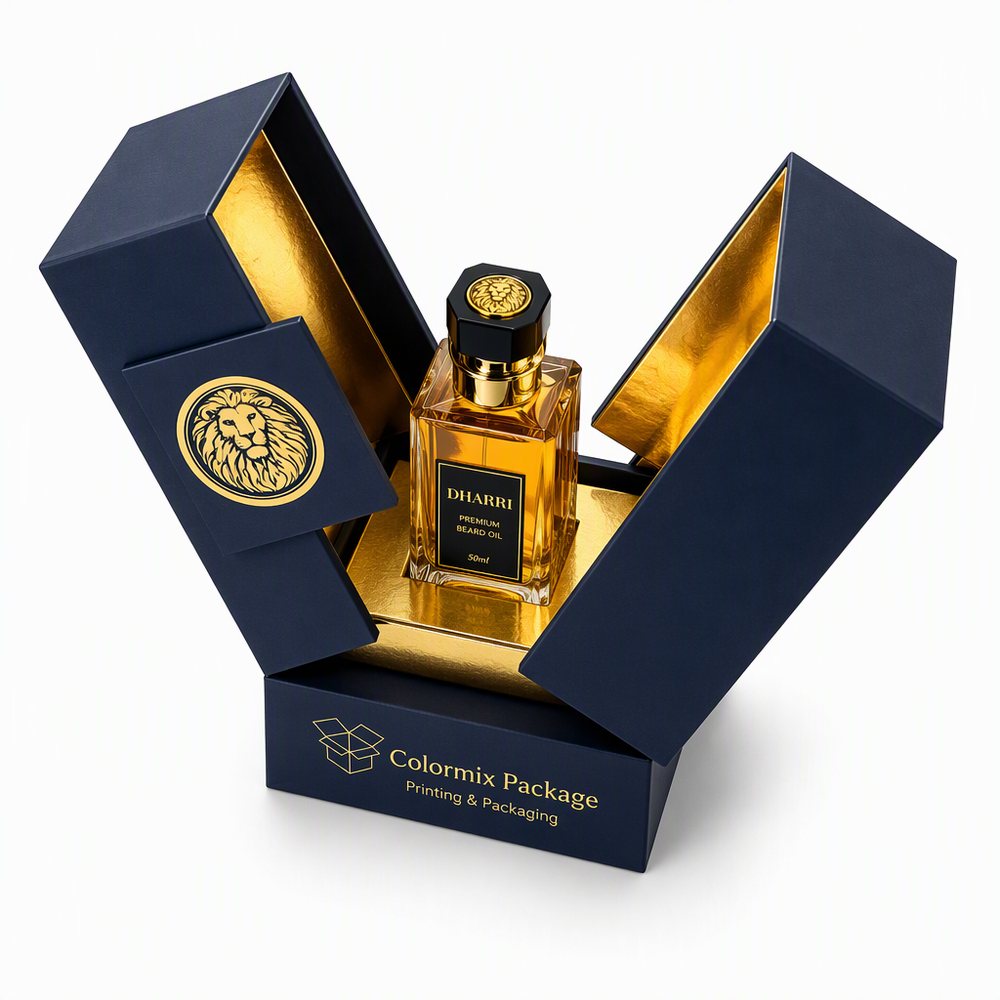
Double-door and book-style presentation boxes open outward so the bottle stands free in the centre, which is why they cost more per unit than a lift-off lid. They are chosen when the box itself is part of the gift.
04
Retail and travel retail need a closure that shows interference, such as a magnetic flap under a seal label or a sleeve that must be broken. Direct-to-consumer orders need an outer mailer that absorbs impact before it reaches the presentation box.
Most brands in this category need three or four of these, not one. Each is quoted separately.
| Component | How it is built |
|---|---|
| Double-door presentation box | Two hinged panels open outward around a fixed platform, with a gold or coloured interior and a magnetic or ribbon closure. |
| Book-style magnetic box | Lid hinged on the spine with concealed magnets, a foam or pulp cradle for the flacon and a pocket for the cap or a sample vial. |
| Rigid shoulder box | Necked shoulder silhouette that follows the bottle outline, built on 1.5-3 mm greyboard with a wrapped paper shoulder. |
| Discovery-set carton | Folding carton or small rigid box with a multi-cavity insert for four to eight vials, printed inside and out. |
Three finishes do most of the work here. The full library, photographed as macros, sits on its own page.
Metallic paper or foiled board behind the bottle.
Matte navy or black, foil only on the mark.
One gloss element on a matte field.
Yes. Send the filled bottle, or its drawing with cap and shoulder dimensions. The die-line is drawn to the actual object rather than to a nominal size, and a physical bottle is more reliable than a spec sheet.
Yes. The presentation box and the e-commerce mailer are quoted together so the inner box fits the outer with clearance on every face.
Yes. Interior print is common on double-door boxes because both inner panels are seen as the box opens. It is printed on the wrap before assembly.
500 pcs per size, for every box type.
Get a packaging quote
Product, channel, quantity and target date is enough to start. You get two or three options with the trade-offs, and an itemised quote.
Last reviewed: 2026-10-27